The short answer
New Hampshire's HB 577, signed by Governor Kelly Ayotte and in effect since July 1, 2025, is the biggest expansion of homeowner ADU rights in the state since 2016. It requires every town that allows single-family homes to allow one accessory dwelling unit, attached or detached, as a matter of right, up to 950 square feet. Towns can no longer push you through a conditional use permit, can no longer ban backyard cottages, and must let you convert an existing detached garage even when it sits inside a setback. Owner-occupancy rules can stay, parking is capped at one extra space, and you still need a building permit and septic approval. For a Southern NH homeowner, that is a real path to rental income, an in-law suite for aging parents, or a downsizing move without leaving your lot.
What HB 577 actually did
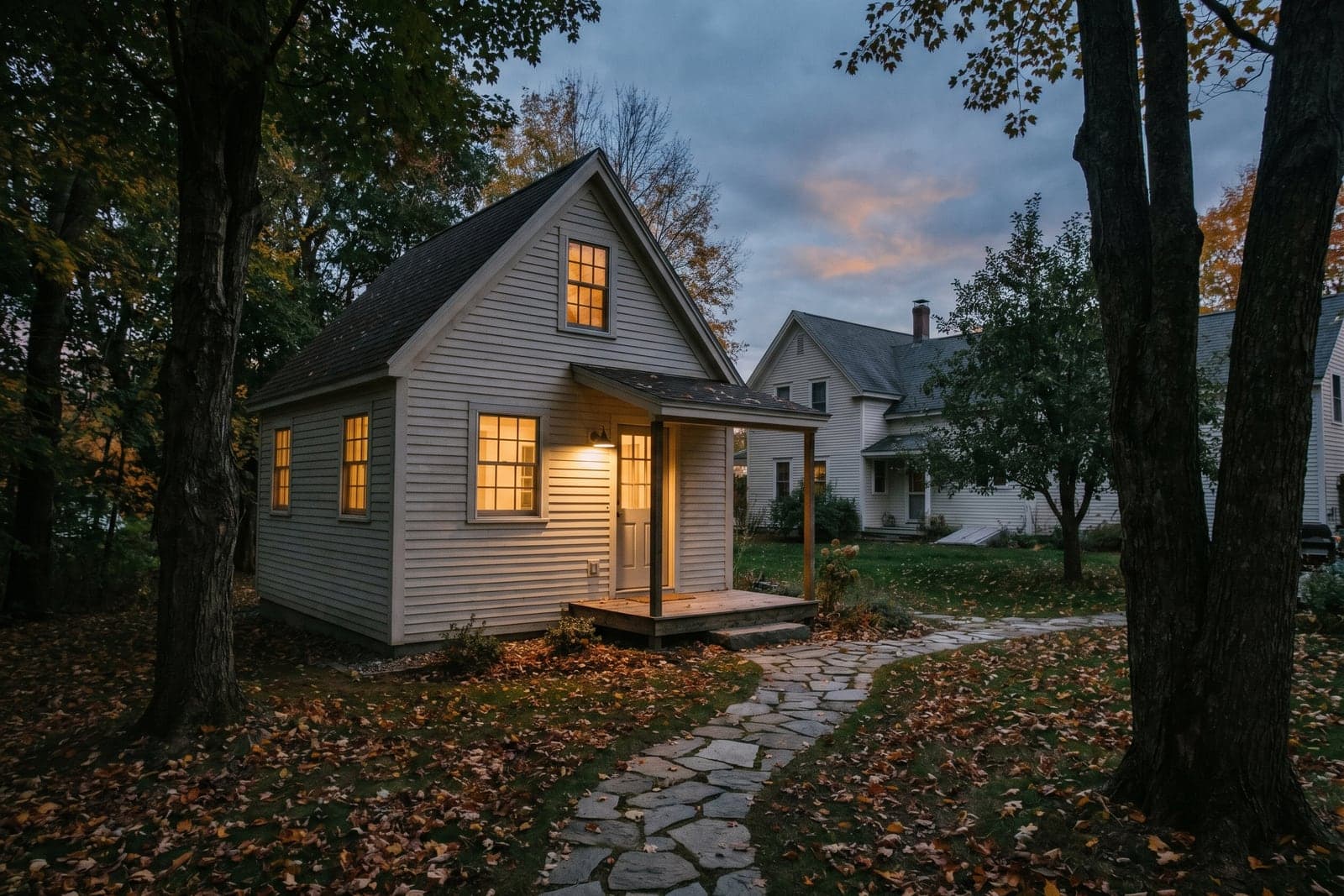
An accessory dwelling unit, or ADU, is a second smaller home on the same lot as a single-family house. An in-law suite over the garage, a finished basement apartment, a backyard cottage. New Hampshire first guaranteed attached ADUs by right under a 2016 law that took effect in 2017. HB 577 is the 2025 expansion, and it is a big one.
Governor Kelly Ayotte signed HB 577 on July 15, 2025, as part of a slate of housing bills, and it took effect July 1, 2025, as Chapter 197 of the Laws of 2025. The core change is simple to say and large in practice: every town that allows single-family homes must now allow one accessory dwelling unit, either attached or detached, as a matter of right. Sources: NH General Court bill status and NH Bulletin's coverage of the signing.
Two phrases there carry the weight. By right means your town can no longer route you through a conditional use permit or a special exception and a zoning-board hearing to build a standard ADU. And detached is now mandatory: under the old law a town could refuse to allow freestanding backyard units, and under HB 577 it must permit one. That single change unlocks the backyard cottage across the entire state.
The numbers your town must now allow
The cleanest reference for the specifics is the state's own before-and-after comparison, the NH Bureau of Economic Affairs HB 577 Summary of Changes. Here is what it spells out.
Size: a town must allow an ADU of up to 950 square feet, raised from the old 750-square-foot floor, and it may not set the limit below 750. Parking: if your town requires parking for the main house, it may require at most one additional space for the ADU, and you choose whether that space is on-site or at a dedicated off-site spot. Bedrooms: a town cannot limit an ADU to a single bedroom, so at least two must be permitted.
A few quieter wins matter just as much. There is no longer a requirement for an interior door connecting an attached ADU to the main house, so a true private unit is allowed. A town cannot deny a separate electrical panel and separate electrical service to the ADU, which makes metering a tenant straightforward. And a town cannot pile on extra setbacks, aesthetic mandates, or design review beyond what it requires for a single-family house without an ADU.
The provision Southern NH homeowners should circle: a town must now allow you to convert an existing structure, including a detached garage, into an ADU even when that structure violates current setback or lot-coverage rules. If you have an old detached garage sitting near a property line, that is very often the cheapest path to a legal rentable unit.
What your town can still require
HB 577 is an expansion of your rights, not a removal of all rules, and getting this part right keeps you out of trouble. The NH Municipal Association's guidance lays out what towns keep.
Owner-occupancy survived. A town may still require that the owner live in one of the two units, though it cannot dictate which one, so a plan to build an ADU on a pure investment property may still run into a local occupancy rule. You also still need a building permit, and if you are not on municipal sewer you need septic approval through the NH Department of Environmental Services, which the town cannot make stricter than the state standard.
One important clarification, because it gets misreported: HB 577 requires towns to allow one ADU by right, not two. A town may choose to allow a second ADU, but it is not required to. Before you design anything, confirm your specific town's ordinance on owner-occupancy, whether it permits a second unit, and its permitting process. A short call to the planning office now saves a six-month correction later, the same advice I give every buyer in the first-time homebuyer checklist.
Why the state did this
New Hampshire has a structural housing shortage built over nearly two decades of underbuilding since the Great Recession. NH Housing estimates the state needs roughly 60,000 new units by 2030 and 90,000 by 2040 to meet demand. Source: NHPR.
The 2025 market shows the pressure. The statewide median home price reached the mid-$500,000s, supply hovered well under two months when a balanced market is closer to six, and a household needed to earn well into six figures to afford the median home without being cost-burdened. Governor Ayotte made housing a centerpiece of her agenda, and HB 577 was one of ten zoning-reform bills she signed in July 2025.
The logic of ADUs is that they add homes without new subdivisions or new roads. A backyard cottage uses land and infrastructure that already exist. The state decided that letting homeowners add one unit each, across tens of thousands of lots, is one of the faster ways to add housing, so it took that decision out of the hands of individual zoning boards.
What this means for you in Southern NH
If you are a longtime owner near retirement, this is the in-law-suite law. You can build a unit for an aging parent, or build the ADU and move into it yourself while renting or handing the main house to an adult child. No familial relationship can be required either way, so the same unit works as rental income if your plans change. It pairs naturally with a right-size move, which I covered in downsizing the family home.
If you are a younger buyer moving up from Massachusetts, an ADU is a way to make the monthly number work. A rentable unit on the property offsets the mortgage, which matters in a market where, as I wrote in why the typical buyer is now 59, affordability is the whole game. Buying a home with ADU potential is buying a house and a small income stream at the same time.
And if you already own a detached garage, you may be holding the cheapest ADU in town. The structure, the foundation, and often the utilities are already there, and HB 577 says the town has to let you convert it even if it sits in a setback. The separate-electrical-service guarantee makes renting it clean.
Every lot and every town ordinance is a little different, so the real answer for your property comes from reading your land and your town's rules together. If you want to know what you could actually build, and what it would mean for your value or your monthly cash flow, book a free 15-minute call and we will look at your specific situation.